Picture the scene: someone discovers a heavy, unusual rock buried in the soil, believing it might conceal gold. This is exactly what happened to David Hole, an explorer using a metal detector near Maryborough, Australia. Instead of uncovering instant riches, he stumbled upon something far rarer—a rock more valuable than gold. What began as a hopeful search for precious metal transformed, years later, into one of the most fascinating modern science stories.
The initial find and years of possession
In 2015, David Hole set out into the fields around Maryborough Regional Park—an area once bustling with fortune-seekers during the gold mining era. Armed with his metal detector, he soon unearthed a reddish, dense stone, notably heavier than any previous finds. Spirits were high, especially since legends of hidden gold still lingered among locals.
For years, this ancient rock remained a source of curiosity and hope. Its remarkable weight and metallic sheen did not match anything typically found in the region. Convinced that gold was hidden inside, every possible method was tried—drilling, sawing, even soaking the rock in acid. Yet nothing could break it open. The object proved tougher than any standard mineral or ore, only deepening the mystery over years of possession.
Museum identification and the real story behind the rock
After countless failed attempts to unlock its secrets, David finally brought the mysterious rock to the Melbourne Museum. There, experts instantly realized that it was no ordinary find. Their museum identification revealed that this was not a gold nugget or local mineral—it was a rare meteorite discovery from beyond Earth. Quickly dubbed the “Maryborough meteorite,” the specimen generated excitement among scientists and the community alike.
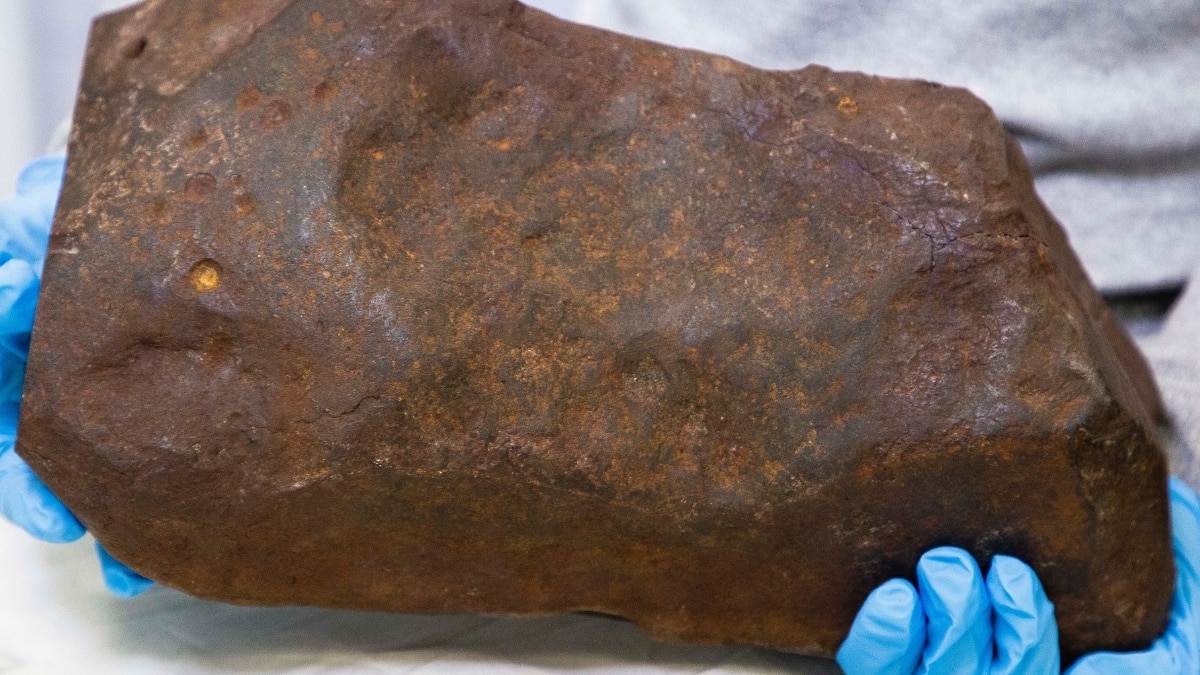
This revelation changed everything. In a workshop or shed, the rock looked like another forgotten relic. But under museum lights, its sculpted surface—shaped by superheated atmospheric entry—became unmistakable. Such features are almost never seen on rocks formed locally, underscoring the meteorite’s extraordinary origin.
What makes the meteorite so special?
Scientific significance of the find
The rarity of this meteorite cannot be overstated. Experts at the Melbourne Museum identified it as a 17-kilogram H5 ordinary chondrite, placing it among some of the oldest known materials in the Solar System. Inside, they found ancient chondrules—small, grainy spheres dating back 4.6 billion years, long before planets like Earth existed.
These chondrules provide researchers with a rare glimpse into the early Solar System. Meteorites like this may contain stardust and organic molecules, remnants from planetary formation. That such invaluable scientific material sat unnoticed for years highlights nature’s capacity to surprise and inspire awe.
A rare treasure: more valuable than gold
While gold has fueled dreams and migrations across Australia, a meteorite like the Maryborough specimen appears maybe once in a generation. Weighing 17 kilograms, it became only the 17th meteorite ever discovered in Victoria, making it exceptionally rare. Because so few exist, these space rocks are prized by both scientists and collectors, valued far beyond their weight in gold. Other historic discoveries linked to shipwrecks and treasures demonstrate how true value can sometimes lie hidden for centuries; for example, there was a recent recovery of one million dollars in gold and silver coins from a three-century-old shipwreck off Florida’s coast.
The true worth of such a find goes beyond money. Each new meteorite discovery advances planetary science, uncovers chemical processes from billions of years ago, and can even reveal clues about life’s origins if organic matter is present. Every addition to a collection creates opportunities for fresh scientific breakthroughs.
Unveiling the journey: from asteroid to the Australian bush
The journey of the Maryborough meteorite captures the imagination. Studies suggest it originated in the asteroid belt between Mars and Jupiter, drifting through space for millions of years before a collision sent it toward Earth. Eventually, gravity pulled it down, embedding it in the soil near Maryborough.
Carbon dating indicates the meteorite landed on Earth between 100 and 1,000 years ago, predating much of the region’s recorded history. Few objects touchable today possess such an ancient and mysterious heritage. For local residents, discovering such a visitor hidden in familiar landscapes demonstrates how cosmic events leave their mark everywhere.
Lessons from mistaken for gold stories
The lure of discoveries by metal detector
Metal detectors have produced many remarkable finds, from lost relics to coins from historic gold rushes. Even experienced explorers sometimes encounter surprises when expectations clash with reality. Here, hopes for a jackpot led instead to a genuine fragment of the early Solar System—a discovery far richer than anticipated.
Meteorites are often mistaken for gold due to their unusual density and iron-rich composition. Without specialized tools or expertise, telling the difference between an earthly metal and an extraterrestrial treasure proves nearly impossible.
How museums help rewrite the story
Bringing mysterious rocks to institutions like the Melbourne Museum offers proper validation and insight. Museums connect discoveries to curators who analyze them using advanced techniques. As David’s experience shows, such collaboration can transform humble field finds into headline-worthy scientific contributions.
These organizations also play a vital role in public education, inspiring future explorers and helping communities appreciate both the ground beneath their feet and the cosmos above their heads.
- Discovery by metal detector can yield unpredictable treasures.
- Meteorite finds offer research opportunities unavailable with traditional minerals.
- Proper identification transforms private finds into sources of public fascination and learning.
- Rare specimens carry not just financial worth, but invaluable scientific significance.
The legacy of the maryborough meteorite
This exceptional find reminds everyone that the ordinary might hide the extraordinary, even right under a metal detector. A rock more valuable than gold, held for years without anyone knowing its true story, now stands as both a marvel of chance and a pillar of scientific knowledge.
Sometimes, those searching for fortune end up changing the course of science. The legacy of the Maryborough meteorite inspires wonder and teaches a key lesson: not everything that glitters is gold—and sometimes, that is the greatest discovery of all.