Picture the excitement of stumbling upon a mysterious, heavy rock and holding onto it for years, believing it might conceal hidden treasure. This was exactly the case for one Australian man whose chance discovery would eventually lead to a revelation far beyond his wildest dreams. After years of possession, what seemed like a possible gold nugget turned out to be something infinitely rarer—and much more valuable.
The discovery that sparked hope
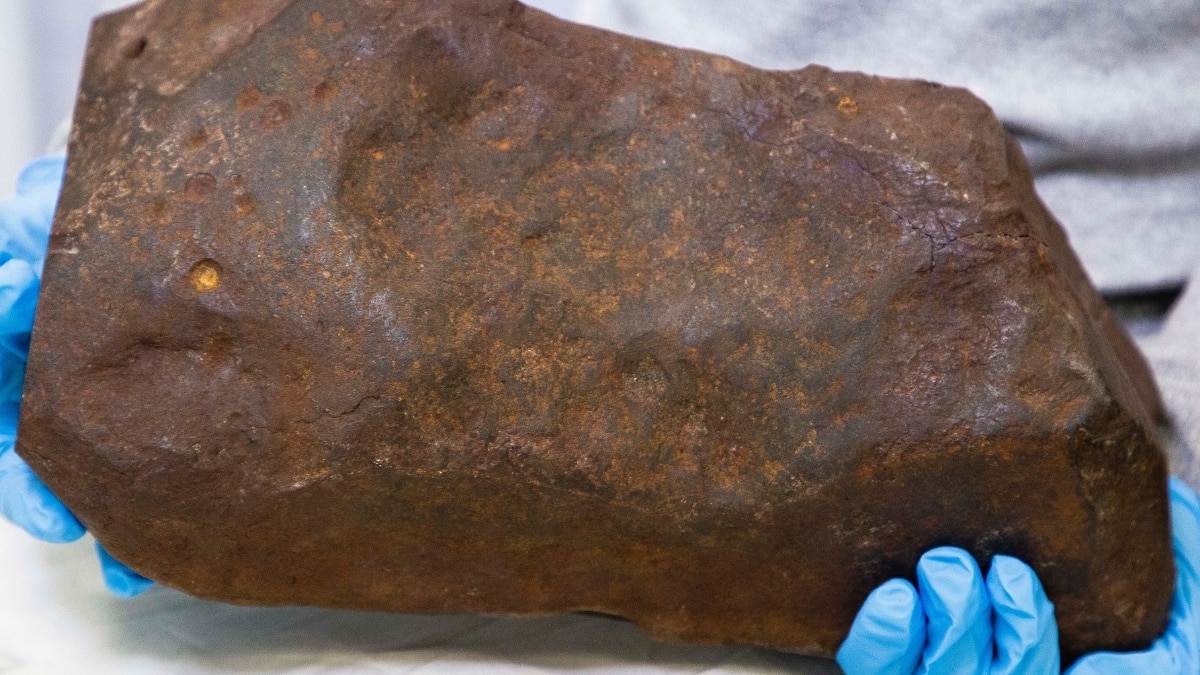
In 2015, in Maryborough, Australia, the story began. While searching with a metal detector, David Hole expected nothing more than the usual bits of metal buried beneath the surface. Instead, he unearthed a hefty, reddish stone. Its remarkable weight immediately raised suspicions that this was not just any ordinary rock. The find evoked visions of unearthing gold—the dream of every prospector.
Inspired by tales of lucky individuals discovering gold, he took the rock home, convinced there might be riches within. With high hopes, he set about trying to uncover its secrets, eager to see if fortune had indeed smiled on him.
Attempts to unlock the rock’s mystery
The belief that the stone contained gold led to a series of determined attempts to break it open. Saws, drills, and even acid were used in efforts to reach the rock’s core. Despite these efforts, nothing could penetrate its tough exterior. Week after week, the rock remained unyielding, refusing to reveal anything resembling gold.
This stubborn resistance only intensified curiosity. What kind of stone could withstand such force? Clearly, this was no typical geological sample uncovered near Maryborough—the rock’s mystery deepened with each failed attempt.
Unveiling the true rarity at the Melbourne Museum
After exhausting all options at home, David Hole decided expert help was needed. He brought the unusual object to the Melbourne Museum, where scientists quickly realized it was not a gold-bearing rock. Their analysis revealed something extraordinary: the Maryborough meteorite.
This specimen weighed a staggering 17 kilograms and featured sculpted grooves formed during its fiery journey through Earth’s atmosphere. As experts examined the rock, its cosmic story emerged—a tale far surpassing any terrestrial treasure. Meteorites are exceedingly rare, and this discovery was among the most significant ever found in Victoria.
What makes the Maryborough meteorite extraordinary?
- This meteorite is classified as an H5 ordinary chondrite, meaning it is rich in iron and holds immense scientific value.
- The distinctive hollows and grooves on its surface were sculpted during entry into Earth’s atmosphere, revealing its extraterrestrial origin.
- Inside, ancient chondrules—tiny mineral grains—were discovered, dating back 4.6 billion years to the dawn of our Solar System.
The composition of the meteorite distinguished it from anything formed on Earth. Carbon dating suggested it landed between 100 and 1,000 years ago. In all of Victoria, only 17 confirmed meteorites have ever been found, making this far rarer than any local gold nugget.
Owning such a fragment of solar system history captured the attention of scientists and collectors alike. The initial hope of finding gold was soon eclipsed by the scientific significance now attached to the discovery.
How meteorites like this deepen scientific understanding
Meteorites serve as time capsules from the earliest days of planetary formation. Studying specimens like the Maryborough meteorite gives researchers direct insight into processes that occurred billions of years ago.
Experts believe this meteorite originated in the asteroid belt between Mars and Jupiter. Each embedded chondrule tells a unique story of cosmic dust compacted under extreme conditions before becoming part of a protoplanetary body.
Unlocking clues to our Solar System’s past
The oldest chondrules offer valuable information about the environment of primordial nebulae. By analyzing their makeup, scientists can determine which elements were present and how they interacted over millions of years. This helps reconstruct the timeline of planetary formation and evolution.
Some meteorites even contain traces of stardust or organic molecules. Researchers search for evidence that these compounds may have traveled to Earth aboard ancient rocks, possibly delivering key ingredients for life itself.
The value beyond gold
Although gold is prized by prospectors, rare meteorites like the Maryborough specimen are considered treasures of far greater worth due to their scarcity and the knowledge they provide. These stones arrive from space bearing information unavailable from any other source.
Discoveries of this nature expand humanity’s understanding of the universe and inspire future exploration. Each meteorite offers answers to fundamental questions about our origins, making them vastly more precious than any bar of gold.
The legacy of years of possession
The long period between the man’s discovery and the meteorite’s identification only adds to the intrigue. For years, the rock was kept in hope that it contained gold, but destiny held a different outcome. In the end, patience and curiosity delivered an answer beyond imagination.
This chapter in Australia’s history is a testament to perseverance. To unknowingly hold a piece of the cosmos—priceless for both its rarity and the glimpse it provides into the creation of planets and stars—is truly remarkable.
Unexpected treasures unearthed in familiar places
Using a metal detector always brings a sense of adventure, never knowing what might lie just beneath the surface. Sometimes, discoveries like the Maryborough meteorite transform ordinary fields into sites of wonder, offering new perspectives on the world around us.
For those exploring with a metal detector, this story serves as a powerful reminder: never overlook an unusual or stubborn rock. Hidden within could be a story from the stars, waiting to be revealed.