Curious about the most reliable way to prepare sausage in the oven? Baking sausages offers a straightforward, hands-off approach that consistently yields juicy and flavorful results. Yet, the main concern often centers on something quite practical: how long sausages need to cook in the oven. For those seeking an easy dinner solution, these helpful tips cover everything from oven temperature and roasting techniques to baking versus broiling and proper internal temperature checks.
Choosing the right oven temperature for sausage
Selecting the ideal oven temperature is essential for achieving juicy sausages. Most recipes recommend setting the oven to 375°F (190°C), as this ensures thorough cooking and promotes even browning. Increasing the heat above 400°F (205°C) can speed up the process, but risks drying out lean varieties or burning the casings before the insides are fully cooked.
Some may consider lowering the temperature to avoid dry sausages. However, baking below 350°F (175°C) significantly lengthens the cooking time and can prevent developing that signature crispy snap. Cooler temperatures work best with extra-fatty sausages or when baking large batches together. Generally, starting with a preheated oven at 375°F delivers consistent, delicious outcomes nearly every time.
Understanding the ideal cooking time for sausages
On average, pork or beef sausages of standard size require about 25-30 minutes in the oven. Thin breakfast links will finish faster—usually within 15-20 minutes—while larger Italian sausages or bratwursts might need 30-35 minutes. Remember to flip sausages halfway through to encourage even browning and ensure they cook evenly without becoming too crisp on one side.
Always factor in the type and thickness of sausage. Variations like chicken or turkey sausages often bake a bit quicker due to their lower fat content, so begin checking after 20 minutes to avoid overcooking. Patties, compared to links, tend to brown more evenly and finish sooner when arranged on a lined sheet pan.
The role of flipping sausages and even browning
Skipping the step of flipping sausages can result in uneven cooking and inconsistent color. Turning each sausage midway through the bake encourages even browning and prevents tough spots. Using tongs, flip each link gently at the 12- to 15-minute mark for best results.
Whether preparing fresh or smoked sausages, flipping remains crucial for a golden crust and moist interior. Lining the sheet pan not only helps distribute heat but also prevents sticking, making it easier to achieve an attractive, uniform appearance.
Baking vs broiling: which method works best?
When should baking be chosen?
The baking or roasting method suits nearly all types of sausage, whether Italian, spicy pork, or herby chicken. Baking uses gentle, indirect heat, offering flexibility with rack placement and allowing multiple trays to cook at once.
Baking is particularly practical when feeding a group, as it minimizes splatter and simplifies cleanup compared to frying. The steady oven temperature ensures even cooking from edge to center—a must for thicker links or mixed platters containing patties, vegetarian options, and regular sausages together.
What sets broiling apart?
Broiling exposes sausages to intense direct heat from above, quickly crisping the skins and speeding up the overall cooking process. For those who prefer a browned, slightly charred exterior, broiling delivers bold flavor but demands close attention since thin sausages can overcook rapidly.
A common technique involves baking sausages until almost done, then switching to broil for two or three minutes to achieve extra color or crispiness. Keep a watchful eye to avoid burning during this final stage.
Tips for checking doneness: internal temperature matters
How to use a meat thermometer effectively?
For both safety and optimal texture, always verify the internal temperature using a dependable meat thermometer. The USDA advises reaching at least 160°F (71°C) for pork or beef sausages, and 165°F (74°C) for poultry-based versions. Insert the probe into the thickest part—avoiding the casing—to obtain an accurate reading.
This step guarantees thorough cooking and helps prevent dryness or splitting. Even experienced cooks rely on a thermometer rather than appearance alone, especially when dealing with various sizes or mixed trays.
Signs the sausages are fully baked
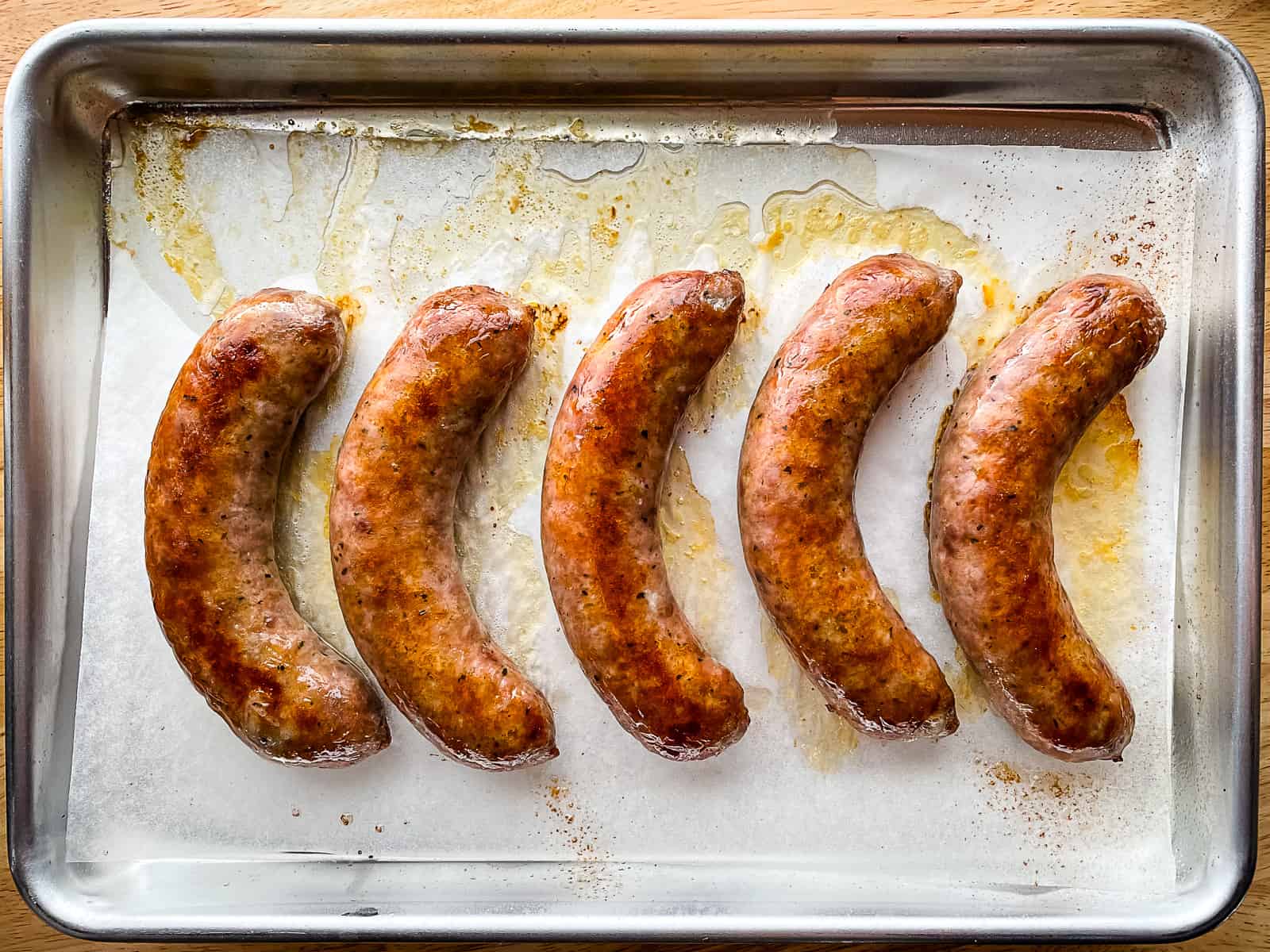
Beyond temperature, visual cues offer guidance: clear juices, tight glossy casings, and slight blistering indicate doneness. If any pinkness remains, allow several extra minutes, rotating the sausages again if needed.
Cutting into a sausage allows evaluation of texture throughout. For patties, gently prick the center to check for firmness—a soft spot means additional baking is required. Attention to these details becomes even more important with homemade or specialty sausages filled with vegetables or cheese.
Special considerations for different types of sausage
Different sausage styles benefit from subtle adjustments. For example, Italian sausage links respond well to an initial short burst of high heat, followed by lower-temperature baking until reaching the correct internal temperature. Chicken or turkey sausages favor moderate, steady heat to maintain tenderness and protect delicate casings.
Patties offer unique advantages, cooking quickly due to their shape. Arrange them in a single layer, spaced apart for best results. When working with smoked links, a slightly lower oven temperature enhances smoky flavors and reduces the risk of bursting.
Should sausages be cooked from frozen in the oven?
Practical steps for frozen sausages
Cooking sausages directly from frozen eliminates the need for defrosting and saves preparation time. Simply extend the baking time by approximately 10-15 minutes beyond the usual range. Arrange sausages with space between them to promote browning and prevent steaming.
The recommended oven temperature remains 375°F (190°C). Space out flipping intervals slightly to account for slower thawing early on. Always confirm doneness with a meat thermometer, as visual cues alone may not suffice with frozen products.
Why air circulation is crucial when baking from frozen?
Ensuring adequate air flow around each sausage enables hot air to circulate and aids both thawing and cooking. Crowding leads to soggy, unevenly cooked links, especially with dense varieties or when preparing large trays straight from the freezer.
Elevating sausages on a wire rack set over a baking sheet boosts airflow and encourages crispier skin, even when starting from frozen. Adjust oven racks to position sausages near the center heat source for the most reliable outcome.
Simple checklist for oven-baked sausages
Perfecting oven-baked sausage comes down to following a few proven guidelines. Consistency develops naturally with careful timing and attention to detail.
- Preheat oven to 375°F (190°C) for the best balance of browning and juicy interiors.
- Arrange sausages in a single layer on a lined or lightly greased sheet pan.
- Flip sausages halfway through baking for uniform color and texture.
- Check internal temperature with a meat thermometer: 160°F/71°C for pork/beef, 165°F/74°C for poultry.
- Add 10-15 minutes if cooking from frozen, adjusting as needed for size and quantity.
- Finish under the broiler for extra-crispy skins, if preferred.
Regardless of the choice—Italian, spicy, classic bratwurst, or simple patties—the right oven temperature and attentive roasting or baking method guarantee satisfying results in every bite.